My Modern Met informs us the UK/Ireland division of the Subway restaurant chain has created a functional sleeping bag that looks like one of its iconic sandwiches.
The art project is called "Sleeping Bag-uette." It's modeled on Italian B.M.T. sandwich, but doesn't taste as good because it's made of fabric.
The company commissioned the project to promote its food with music festival attendees.
You can see a video of the sleeping bag in action on Instagram.
Some serial killers commit murder in the furtherance of other crimes, like bank robbery. Some do it for a sexual thrill. Some are lashing out at a world they believe did them wrong. But it takes a truly terrifying personality to kill over and over for no discernible reason at all. Experts go back and forth about psychopaths- are they a product of an awful childhood or are they born that way, and is that condition even real?
The 20th century blueprint for psychopathy are the crimes of 19-year-old Charles Starkweather and his 14-year-old girlfriend Caril Ann Fugate. Starkweather committed his first murder in November of 1957. Then on January 21, 1958, he killed Fugate's parents and two-year-old sister. Over the next eight days, the two traveled around Nebraska and Wyoming, killing almost everyone they encountered. The sensational murders inspired several movies including Badlands in 1973 and Natural Born Killers in 1994, plus the Bruce Springsteen song "Nebraska." Weird History brings us the story of Starkweather and Fugate and the trail of dead bodies they left behind them.
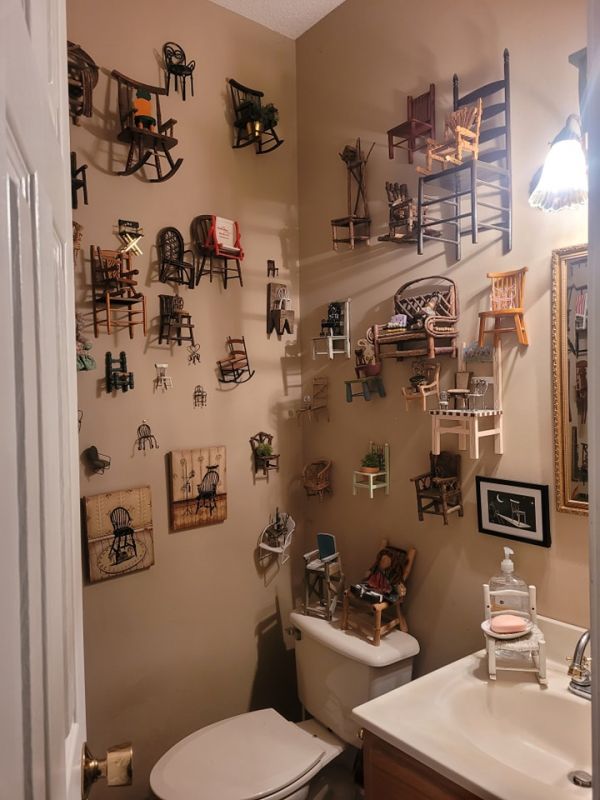
The sitting room, of course. Lorelei Teegarden shared images of her grandmother's half bath, where she keeps her collection of miniature chairs. It's a work in progress, since she's been collecting them at least since Teegarden was a child. There are over 100 chairs at the time this picture was taken, and many are smaller chairs sitting on chairs. After posting pictures, other people offered to send her more miniature chairs.
Honestly, a bathroom is the perfect place to display an eccentric collection, although I suspect this choice was in service of the pun. If you've always wanted to decorate a room in purple, black, or mermaids, the bathroom is the place to go wild. They are usually small rooms not easily visible from the rest of the house, so a different look will not disrupt the style of the home as a whole (much). Imagine you just have to "go," and find yourself among this delightful collection- you can't help but smile. See more pictures of the sitting room at Facebook. -via Messy Nessy Chic
You know this song- "We've Only Just Begun" by The Carpenters. It was heard at every wedding you went to for about twenty years, and a lot of graduations, too. You might think it pretty clever for a bank to use it in an ad inviting young couples to establish their accounts. But couldn't they afford to use the hit version?
But that's backwards. "We've Only Just Begun" was written by Paul Williams and Roger Nichols specifically to advertise The Crocker Bank in Mendocino, California. Local non-actors were recruited to appear in the commercial, which debuted in 1970. Richard Carpenter heard the ad, liked the song, and reached out to the ad agency for the music rights. The Carpenters recorded an expanded version that proved to be a hit and helped them win the Best New Artist Grammy in 1971. It's not the only advertising jingle that was so catchy it became a song, as you will learn in a list of nine such stories at Mental Floss.
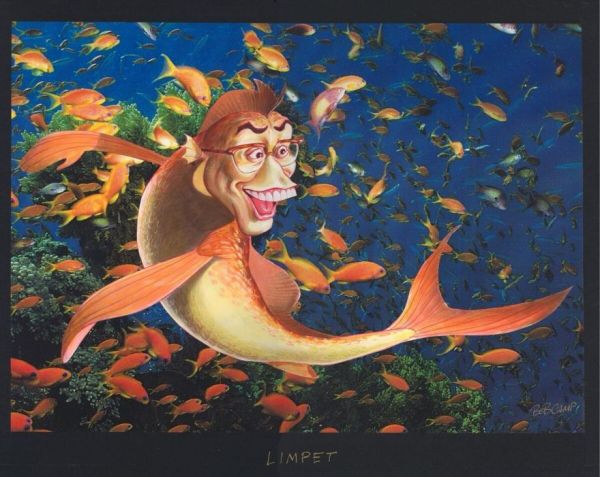
The Incredible Mr. Limpet was a 1964 film starring Don Knotts as a man who magically turns into a fish and helps the Allies win World War II. It was a mix of live action and animation, and Mr. Limpet was drawn as a fish who had Knotts' most recognizable features. The movie was not a big hit, and today has a 40% rating on Rotten Tomatoes. I loved it, only because I was five years old. So you might be surprised to learn that Hollywood spent years trying to produce a remake starring Jim Carrey.
The problem was that Carrey would be an animated fish for most of the film, and in the late '90s, he was a superstar and just too expensive to star in a movie in which his face wouldn't be shown. They tried to work around that by animating a fish with a photorealistic rendering of Carrey's face using motion capture technology. The results were terrifying, much worse than the drawing shown here. The movie was in development for around 18 years, but the core problem was never really solved, so the project ran out of steam and was abandoned. Read about the remake of The Incredible Mr. Limpet, and see the test footage of the fish with Carrey's face at Cracked.
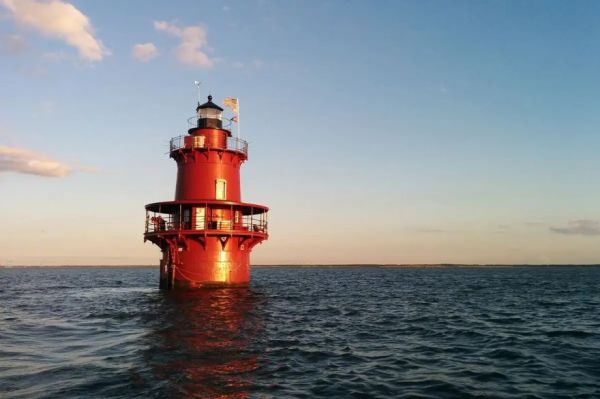
Middle Ground Lighthouse lies off of Newport News in Chesapeake Bay. Though built in 1891, it remains in nightly operation. Northern Virginia magazine reports that it's also been renovated and is available for sale as a functional house.
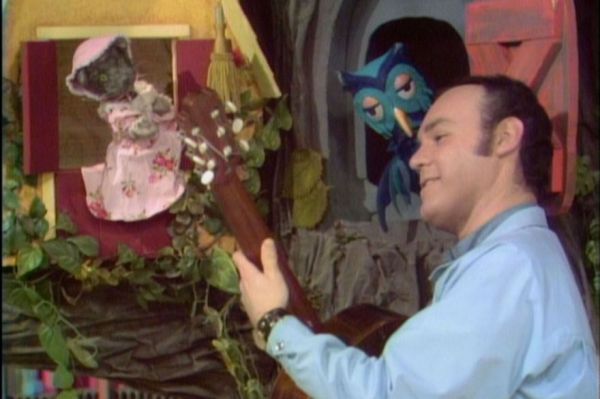
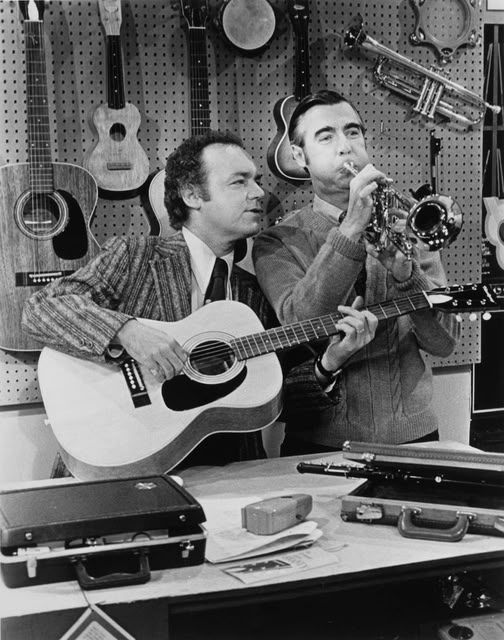
Joe Negri had been a child prodigy as a musician and was a local star in Pittsburgh when Fred Rogers hired him to star as a recurring character on his iconic children's television show. As Handyman Negri, this musician interacted with puppets in The Land of Make-Believe and operated a music shop in Fred Rogers's* fictional neighborhood.
*"Rogers" is a singular noun and thus an "s" is necessary to indicate possession, but Fred Rogers did not follow that rule when titling his show, hence the spelling in the post title.
What's the difference between salami and pepperoni? That's easy- salami is for sandwiches, along with cheese and mustard, on rye bread. Pepperoni is for pizzas. Although my dad used to put salami and cheese on a single slice of bread, top it with ketchup, salt, and pepper and put it in the toaster oven. He called it "pizza toast." At that age and era, the only pizza I'd ever had came from a Chef Boyardee kit, so I accepted it.
Getting down to brass tacks, salami and pepperoni are both spicy sausages, but that's where the resemblance ends. One has a history that goes back to the Roman Empire, while the other is an 20th century American invention! They are made differently, have different ingredients, and have their own best uses, as I explained above. The YouTube channel Simple Things - Surprising Histories explains it all, plus an important tip for ordering a pizza in Italy. -via Laughing Squid
Global trade really opened up during the Age of Exploration, but it was an awfully long journey between oceans when you had to sail around the southern tips of Africa or South America and your trading partners were in the Northern Hemisphere. It would be a far shorter trip through the Arctic Ocean, but how? The fabled Northwest Passage was filled with icebergs and unmapped islands and the sea was frozen most of the year anyway. But intrepid explorers spent 300 years looking for that route, with expedition after expedition turning back or becoming stranded. Many died in the search.
The first to successfully find a way around northern Canada and map the Northwest Passage was Norwegian explorer Roald Amundsen, better known as the first man to reach the South Pole. He accomplished this by using a much smaller ship and crew than previous expeditions. The tiny Gjøa was a 30-year-old fishing boat that was only 70 feet long. Amundsen selected only six men for his crew. The expedition set off from Norway in 1903. The ship was indeed icebound twice on the journey, once for almost two years, but the intact ship and crew reached Nome, Alaska, in 1906 and eventually continued on to San Francisco. Read how the Gjøa and crew survived and claimed a new trade route at Amusing Planet.
It's a good day when Bill McClintock comes out with a new music mashup. It's a great day when he mashes up two songs that are this familiar to me, like two old friends that I never knew were friends with each other. Here we have Queen's "We Will Rock You" mixed with "Paranoid" by Black Sabbath. This required some messing with the tempo, but if anyone can make it work, it's McClintock (previously at Neatorama). He calls this song "Rockanoid."
Oh, but that's just the beginning. There are nine, count 'em, nine other rock-themed songs included in this mashup: "Sad But True" by Metallica, "Rock of Ages" from Def Leppard, "We Rock" by Dio, both "Let There Be Rock" and "For Those About to Rock (We Salute You)" by AC/DC, "Rock Hard Ride Free" from Judas Priest, "Rock 'n' Roll Rebel" by Ozzy Osbourne, Pat Benetar's "Heartbreaker," and "Rock You" by Helix. Good luck identifying them all in this fast-moving video. The only real drawback I find is that it should be much longer.
An early rondellhund in Linköping, Sweden. (Image credit: Skvattram)
If you've driven around a Swedish roundabout, you may have seen a homemade dog sculpture sitting in the grass center of the circle. They can be found in many places, and they vary widely in design. Who put them there? No one knows, and it's certainly not just one person. The roundabout dog, or rondellhund, is a real-world art meme, and it started in the Swedish city of Linköping. Wikipedia has the story of the first rondellhund that appeared in 2006.
A rondellhund in Vårdsberg, Sweden. (Image credit: Peter Forss)
People just liked the first dog, so they anonymously installed other dog sculptures in roundabouts in Sweden, or in traffic islands in smaller towns that have no roundabouts. The practice spread to other countries, including Spain, Portugal, and the UK.
This roundabout dog was spotted in Braga, Portugal. (Image credit: Bjornjobb)
Most roundabout dogs are made of wood, but other materials are also used. There is no set design, and each fabricator puts their own spin on them. You can buy one from a company that makes them in custom colors, although from the pictures, those seem to end up at people's homes more than in public roundabouts. -via Metafilter
Laurence Brown goes through the differences between housecleaning in the US and Britain. The US has air conditioning, which means cleaning AC filters as well as filters for the heating, the dryer, the dishwasher, the vacuum cleaner, the car, the lawn mower, and the fish tank. Further climate control methods mean you need to clean the ceiling fans in America. Meanwhile in Britain, dishes are washed by hand and some people don't rinse the soap off of them! Does this mean they get a lot of soap buildup in their drying towels, or are you just eating detergent with your next meal?
Personally, I am glad that wall-to-wall carpet is declining in the US. You can clean carpets all day, every day, and they are still nasty, especially if you have children or pets or a spouse or a garden. I have my own system of house cleaning, called procrastination. I need true motivation to do it, like company coming over.
Note: Fairy washing up liquid is made by Proctor and Gamble, and its the same formula as Dawn dishwashing liquid in the US. This video has a one-minute skippable ad at 3:30.
The ‘girl with the pearl earring’ by #Vermeer will come to #Osaka in August during the renovation of the #Mauritshuis museum in The Hague. Judging from the press-conference, she is very popular in #Japan. Maybe this is her last tour, since she is ‘advancing in age’ like all of us pic.twitter.com/I862Y1XUNi
— Dutch ambassador to Japan (@GillesBP) May 27, 2026
For the first time in a decade, Johannes Vermeer's masterpiece Girl With a Pearl Earring is traveling outside of Netherlands. The artwork will go on display at the Nakanoshima Museum of Art in Osaka in August. To announce the exhibit, the museum held an event attended by a life-size version of a rabbit character called Miffy, dressed as the subject of the painting. The event went viral.
Miffy, who is hugely popular in Japan, is also a Netherlands export. She was created by Dutch artist Dick Bruna, who later sued Hello Kitty company Sanrio over their suspiciously similar rabbit character named Cathy. Using Miffy as a "spokesrabbit" for the Vermeer loan appears to have many layers.
Girl With a Pearl Earring normally resides at the Mauritshuis in the Hague, which is closed for renovations. But you can order a crocheted Miffy doll in the Pearl costume through their online shop. Both the costumed character and the doll have a pearl earring, but strangely it is not attached to the rabbit ears. -via Everlasting Blort
The internet began as "a complicated, global interconnected system almost entirely made up of people who do not want to be told what to do." This was fine for free countries, mostly, although anyone could see how scammy and toxic the system could become. But what about totalitarian nations who were used to controlling what information their citizens are exposed to? China saw the danger early, and locked down what kind of access they would allow. Russia was busy going through a lot of changes in the 1990s, and confronted the danger to government oppression relatively late in the game. But when they did, it was like holding back a flood with a bucket. One method of controlling the World Wide Web they use is to block sources from outside of Russia, directly and also indirectly by making the whole internet slow and creaky. At the same time, they created their own internet services, from providers to websites to social media platforms, that seem like just weird, ersatz alternatives in order to censor what Russians see. Half as Interesting takes us on a tour of the odd Russian internet.
A movie about weather forecasting doesn't sound all that exciting, until you realize that one forecast was the difference between life and death for an invading force, and even the course of the entire war. That's the premise of the movie Pressure that opened this weekend- the weather forecast for the D-Day Invasion of Normandy. Brendan Frasier plays General Dwight Eisenhower and Andrew Scott plays James Martin Stagg, the chief meteorologist of the Allied forces in Europe. The tension is between meteorologists who disagreed on what weather would greet the invading Allies, and whose advice Eisenhower would trust when he set the date.
The movie, as you might expect, plays around with the timeline and emphasizes relationships between characters that probably didn't happen as portrayed. But the competing forecasts are real. Stagg was actually a geophysicist and was surprised at his assignment. He had a different philosophy of weather forecasting that was often at odds with meteorologists, especially US Army forecasters led by Irving P. Krick. These forecasting methods as used for the D-Day decision are explained at Smithsonian. It contains movie spoilers, if you aren't already aware of what date the Allies invaded Normandy. -via Strange Company